
My Take: Why Liquid Web Made This Move

A lot of people in the WordPress space reacted strongly on May 12, 2026 when the StellarWP websites started redirecting to Liquid Web landing pages. Suddenly brands like Kadence, LearnDash, GiveWP, The Events Calendar, IconicWP and others looked like they had disappeared overnight.

I saw many tweets calling this “the end of an era”, and I understand the emotional reaction. These are products many of us have used for years. Some of these companies were founder-led businesses with strong identities, loyal communities, and recognizable brands at WordCamps and across the WooCommerce and WordPress ecosystem.

They also carried a lot of SEO value, years of backlinks, and strong brand recognition within the WordPress ecosystem. These were not random plugin websites. They were established businesses that many people trusted and followed for years.

Still, I think the reaction became bigger than the actual situation. My opinion is that this is not a shutdown story. It’s a consolidation story.

Continue reading My Take: Why Liquid Web Made This Move

Let’s Stop Stressing About WooCommerce Market Share

Close-up of eyeglasses on a table with colorful business charts.

Everyone keeps asking the same thing… what’s WooCommerce market share right now?

And depending on where you look, you’ll get a different answer. One source says one thing, another says something else. It goes up, it goes down, sometimes it feels like it changes every week. And yes, it’s kind of interesting… I get it.

But here’s the thing: we’ve slowly turned that number into a scoreboard.

If it grows, we relax. If it drops, we panic. If it stays flat, we start wondering what’s wrong. Meanwhile, the actual work—building, improving, communicating, supporting the ecosystem—doesn’t really change.

In this article I want to share a simple idea: we probably need to stop stressing about WooCommerce market share. And that’s because it’s not the thing that will move WooCommerce forward.

There’s always work to do anyway… product, developer trust, communication, community, brand. Even if the number was 99.9%.

Continue reading Let’s Stop Stressing About WooCommerce Market Share

An Open Letter to WooCommerce and the Woo Community

Dear WooCommerce,

If there’s one thing Checkout Summit confirmed for me, it’s that what we’ve built around Woo is bigger than software.

For 14+ years, I’ve been inside this ecosystem. Working with small, medium, and large clients, building products, teaching developers, solving merchant problems, speaking with agencies, and watching thousands of businesses choose WooCommerce as the engine behind their livelihoods.

You spend enough time in an ecosystem like this and you start to understand its rhythm—its strengths, its weaknesses, and the things that keep it moving.

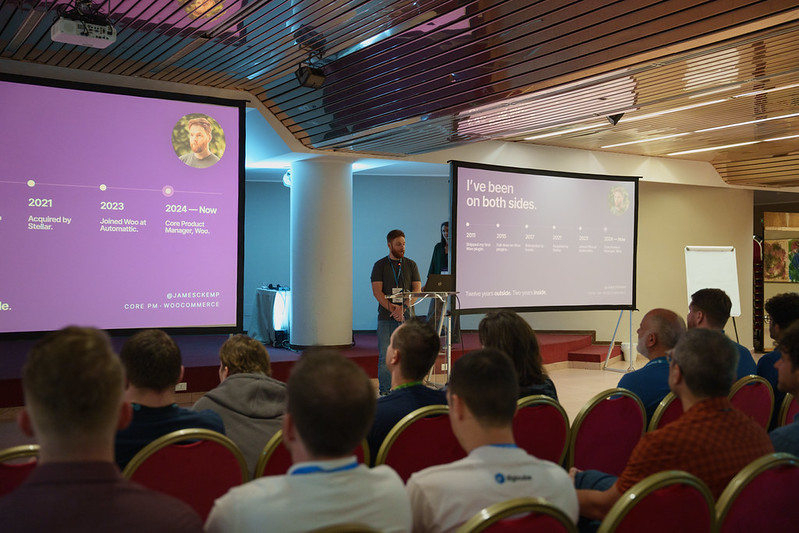
Last week in Palermo, something happened that reminded me why this ecosystem still matters so much. Checkout Summit brought people into the same room to talk about Woo, face to face, for the first time since WooConf 2017. And walking away from it, I felt compelled to write this.

Because something important is happening.

Continue reading An Open Letter to WooCommerce and the Woo Community

WooCommerce Needs More Noise (The Right Kind)

WooCommerce has never lacked talent. What it’s lacked—at least up until recently—is noise.

I’m not talking about marketing, but real, human, day-to-day signals from the people actually building the plugin. We’ve seen some of it over the past couple of years, and when it happens, it changes everything: clarity improves, trust grows, and the community gathers together.

The problem? It’s still too rare.

At a time when AI is flooding the internet with generated content and competitors are getting louder, silence is risky. If we don’t hear what Woo is working on, thinking about, and struggling with, we’re left in a limbo. And guesswork is where attention drifts.

This isn’t a criticism. It’s a call to action.

Continue reading WooCommerce Needs More Noise (The Right Kind)

We Need To Talk About WooCommerce (More Than Ever)

If we look at competitors, I don’t think we talk enough about WooCommerce. Not nearly enough, at least.

For an ecosystem this big (7+ million active installs according to WP.org, 4 million websites according to StoreLeads, and 6,5 million websites according to BuiltWith), there are few places where developers, agencies, and merchants can come together and have real conversations.

I mean actual “conversations”… and not tweets (which Woo has definitely embraced in the last couple of years) or support threads.

Because if we keep talking, we can move forward as “one”. As a community.

Talking is alignment. It’s knowing what’s coming before it’s announced. It’s understanding the challenges merchants face, what developers are building, and where agencies are focusing their energy.

When we spend time together—sharing ideas, testing new approaches, debating best practices—we’re not just individuals. We become one entity. We make the most of this beautiful open-source project.

We’re one ecosystem that can shape the future of WooCommerce, instead of reacting to it.

Conversations spark innovation. They uncover opportunities. They help us all move faster, smarter, and with purpose. And that’s exactly why creating spaces to talk—online or in person—matters more than ever.

Continue reading We Need To Talk About WooCommerce (More Than Ever)

WooCommerce Devs: WordPress Drama Won’t Stop Us

After a relatively quieter stretch (likely due to the ongoing lawsuits), the WordPress ecosystem is noisy again. We’re back to social media spats, endless threads about contributions, and who’s a “cancer” to the project.

It’s exhausting. And it’s distracting millions of us who just want to build.

So if it bugs you the same way it bugs me—simply unfollow the madness, mute the drama, and get back to shipping.

Plugins keep launching, stores keep converting, extensions keep selling, and the WooCommerce community keeps quietly powering real businesses every single day.

WordPress drama won’t stop us. It never has, and it never will.

Continue reading WooCommerce Devs: WordPress Drama Won’t Stop Us

How the WooCommerce Community Surprised Me This Week

Over the past few days, I’ve been running a little experiment with the WooCommerce community—and let’s just say, it’s been incredible. What started as a simple idea quickly turned into something much bigger than I expected.

I’ve been keeping notes, tracking milestones, and seeing the energy and creativity this community brings to the table. The results so far have been both encouraging and, honestly, quite surprising.

In this post, I’ll take you behind the scenes, share some unexpected moments along the way, and explain why I believe this experiment could serve as an example for anyone in the WordPress ecosystem, and beyond.

Continue reading How the WooCommerce Community Surprised Me This Week

Community Is Still the Best WooCommerce Feature

There are so many reasons why WooCommerce continues to power millions of stores around the world. It’s flexible. It’s open source. It’s customizable. But none of those explain its success on their own.

What truly makes WooCommerce thrive is… us. The community behind it.

For almost 15 years, developers, freelancers, agencies, makers, and merchants have shaped WooCommerce in public. They’ve shared code, answered questions, written tutorials, organized events, built extensions, and helped strangers solve problems at midnight on a Sunday on a random forum thread. That effort has done more than improve the software—it has moved it forward.

In this post, I want to reflect on why WooCommerce continues to stand out in a crowded ecommerce landscape, why community is still its strongest advantage, and why that human layer it’s the real deal (also including a live case study!).

Continue reading Community Is Still the Best WooCommerce Feature