Dear WooCommerce,
If there’s one thing Checkout Summit confirmed for me, it’s that what we’ve built around Woo is bigger than software.
For 14+ years, I’ve been inside this ecosystem. Working with small, medium, and large clients, building products, teaching developers, solving merchant problems, speaking with agencies, and watching thousands of businesses choose WooCommerce as the engine behind their livelihoods.
You spend enough time in an ecosystem like this and you start to understand its rhythm—its strengths, its weaknesses, and the things that keep it moving.
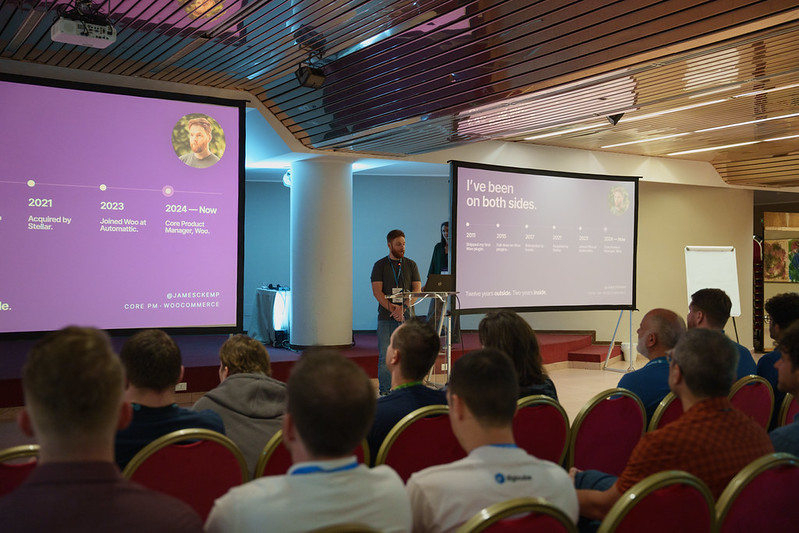
Last week in Palermo, something happened that reminded me why this ecosystem still matters so much. Checkout Summit brought people into the same room to talk about Woo, face to face, for the first time since WooConf 2017. And walking away from it, I felt compelled to write this.
Because something important is happening.
We’re Lucky to Build on WooCommerce
We often forget how fortunate we are to build on open-source software.
In a world where so much of the web is increasingly locked behind platforms, subscriptions, and closed ecosystems, WooCommerce remains one of the clearest examples of ownership and freedom.
Merchants own their stores and data. Developers own their code. Agencies own their processes. That freedom is not a small detail—it shapes the entire culture around the product.
Building on open source creates a very different type of ecosystem. It encourages experimentation. It lowers barriers. It allows someone with an idea to build something meaningful without asking for permission first. That’s how many businesses in this space were born, mine included.
That freedom comes with complexity, of course. Open ecosystems are messier than closed ones. But I’d take that mess every day over the alternative, because it’s exactly what makes WooCommerce worth building on.
Dear WooCommerce: please don't forget we built a community around the concept of "freedom".

Dear community: please use your incredible energy and skills to help WooCommerce with its vision, mission, direction.
Checkout Summit Reminded Me What This Ecosystem Is Made Of
There’s something powerful about getting people in the same room.
For all the online conversations we have every day, there’s still no substitute for sitting across from someone and talking about what’s working, what’s not, and what comes next.
Checkout Summit reminded me that behind every plugin, every store, every agency, and every support ticket, there are people doing real work and making real bets on this ecosystem.
What stood out most wasn’t just the talks. It was the conversations in between. Developers comparing notes. Founders discussing challenges. Agency owners sharing lessons. Sponsors listening as much as speaking. Those moments are where community becomes real.
And what I saw in Palermo was not an ecosystem running on habit. It was an ecosystem running on belief. People still care deeply about WooCommerce, and that matters more than any metric.
Dear WooCommerce: please don't forget we keep betting on the ecosystem. We must grow TOGETHER.

Dear community: please keep betting, no matter what. We can do things and achieve things together, you know?
WooCommerce Is Still the Most Used Ecommerce Platform in the World
That’s easy to forget when you spend too much time online.
Online discourse tends to distort reality. It amplifies competition, trends, and noise in ways that can make you feel like the ground is shifting faster than it really is. But when you zoom out, WooCommerce remains the ecommerce engine behind an enormous part of the web.
That scale matters because it means the opportunity is still massive. Merchants continue to need flexibility. Businesses continue to need ownership. Developers continue to need a platform they can extend and shape. Those needs have not disappeared.
If anything, they’ve become more important. In a digital economy increasingly shaped by dependence on centralized platforms, independence is becoming more valuable, not less.
Dear WooCommerce: please don't stress over usage percentages. Instead, share more, build in public, ship fast, and include us always.

Dear community: please talk to WooCommerce. Write open letters, show up wherever they go, organize calls, and let's all work WITH them.
Competition Is a Gift
Every strong ecosystem needs competition.
Competition forces clarity. It forces innovation. It forces everyone involved to keep improving instead of relying on momentum.
We should be grateful there are other ecommerce platforms doing great work (I will be speaking about “Why WooCommerce loves its competitors” at WCEU 2026).
Their presence sharpens the market and raises expectations for everyone. Merchants compare. Developers compare. Agencies compare. That pressure is healthy.
The existence of alternatives doesn’t weaken WooCommerce. It challenges it to stay relevant, stay ambitious, and stay focused on what makes it unique.
To quote Patrick Rauland, who spoke at Checkout Summit and will retake his amazing presentation during Checkout Summit {Reloaded} on May 7-8, “WooCommerce is like Pepsi and Shopify is like Coke“. On average, Pepsi tastes better than Coke during blind tests. But also on average, people pick Coke over Pepsi when they are allowed to see the brand first.
Dear WooCommerce: we can't compete on marketing spend or team size, but we can surely win on "taste", data ownership, cost of ownership, open-source, community, freedom to customize.

Dear community: please make the most of each single opportunity to meet WooCommerce, contribute to WooCommerce, and help WooCommerce. They need you.
A Lot Has Changed in the Last Few Years
The last few years have been intense for everyone in WordPress and WooCommerce.
None of this happened in isolation. These changes affected every part of the WooCommerce ecosystem, from core contributors to solo freelancers. The environment we’re building in today is very different from the one we were building in 10 years ago.
Most developers and founders I talked to at Checkout Summit are frustrated, to say the least.
And pretending otherwise would be a mistake. Change happened, and it changed us too.
December 2018 was an important moment for the whole WordPress community: Gutenberg made it to core. In fairness, the majority of the developer community said it “was too soon to launch” and that it “should have stayed as a plugin“. We’re in 2026 now, and I’m still hearing this.
The rise of block-based experiences changed how people think about building WooCommerce stores, too. WooCommerce took some time to catch up, integrate and ship its own blocks.
The WooCommerce community split between the “classic/PHP” developers, and the “block/React” developers. Needless to say, we now need a way to reunite.
I believe partly due to this division, on March 3, 2026, WordPress launched “PHP-only block registration“, and now we’re talking. More of this, please.
WooCommerce has also launched its Cart and Checkout blocks, but usage from existing stores is still low. This is because most third party WooCommerce plugins or customization don’t work with blocks, by design.
Gutenberg is, according to me and many others, one of the major frustration for Woo developers right now.
Also, economic pressure changed how merchants spend money. Agencies had to rethink margins, services, and positioning. Product builders had to adjust to changing customer expectations.
And now AI is reshaping workflows faster than most of us can fully process.
We’re in the middle of a revolution (recession?), and most WP/Woo founders/builders/agencies are experiencing revenue loss, client churn, increased expenses, and organic traffic decline.
This has nothing to do with WordPress, probably.
But let’s not forget about the drama of the last couple of years. In all fairness to Matt Mullenweg, he has often been right in his statements, but some of the public dynamics over the past couple of years have also contributed to tension within the community.
A lot of people I admired, left the community all together. This couple of years have affected the community even more, when all we need is direction, contributions, volunteers, PRs, and healthy conversations.
Dear WooCommerce: we know you are a WordPress plugin and "depend on WordPress". But if you need to get something done fast(er), we want to hear your voice.

Dear community: as I stated a few weeks ago, this is the time to "mute the noise, and get back to flood the timeline with progress, not problems".
This Is the Moment to Realign
When markets move quickly, everyone adjusts in their own direction. That’s natural. But over time, ecosystems benefit from pausing and asking bigger questions.
What matters now? What do merchants need most? What should agencies prioritize? Where should developers focus their energy?
Realignment doesn’t mean changing everything. It means reconnecting around what matters most right now. It means understanding the present moment clearly enough to make better decisions for the next few years.
And I believe we’re at that point now. Not because of crisis, but because of opportunity.
Dear WooCommerce: please keep including us in your decisions. Please publish your roadmap. Please, let's set up a 1-day online workshop where you and we work together on direction, mission, value, roadmap, guidelines. We need transparency, you to build in public (more often), and that ALL staff including developers, designers, and marketers launch and maintain their own WooCommerce store.

Dear community: we need more time to talk. I'm working on that, but also I want to know what your ideas and feedback are. Let's help each other, so we can help Woo, so we can run healthy businesses.
Realignment Starts with Conversation
You cannot realign in silence.
Alignment requires conversation, disagreement, perspective, and listening. It requires people from different parts of the ecosystem sharing what they see from where they stand. Developers see one reality. Agencies see another. Merchants see another. Product builders another still.
That’s why events matter.
Checkout Summit wasn’t important because it was an event. It was important because it created space for those conversations to happen. And in those conversations, you start to notice patterns. Shared concerns. Shared optimism. Shared uncertainty. That’s where clarity begins.
Dear WooCommerce: please bring back WooConf (sorry for insisting). Please keep helping online and in-person events. We need to talk about Woo, more often.

Dear community: please step up. Contribute, organize, share, write, speak, pitch, record, build in public, review, interact, connect.
The Next Chapter of WooCommerce Should Be Built Together
No single company, founder, or developer gets to define the next chapter alone.
That’s one of the strengths of this ecosystem. Its future is shaped collectively by everyone contributing to it—whether through code, products, services, education, or community building. That shared responsibility is what makes it durable.
But shared responsibility also requires participation. It requires showing up. It requires investing time, money, and attention into the spaces where ideas are exchanged and direction becomes clearer.
If the next chapter of WooCommerce is going to be strong, it needs to be built in collaboration—not in isolation.
Dear WooCommerce: please include the community in your decision / direction process. We want to hear when ideas are born, not when something is shipped.

Dear community: if we are to keep our businesses alive, we can't just complain or simply "leave". We need constructive feedback.
This Can’t Be the Last Time We Get in the Same Room
Checkout Summit ended, but I hope it was not a one-off.
What happened in Palermo felt important because it proved something.
People will show up for these conversations. They will travel for them. They will invest in them. They want them.
So this is my open letter, both to WooCommerce and to the wider Woo community: keep showing up. Keep talking. Keep building. Keep challenging each other.
If we believe in the value of this ecosystem, then we should believe in the value of protecting and strengthening the spaces where it grows.
And if Palermo proved anything, it’s that we’re far from done.