WooCommerce: Change Add to Cart Quantity into a Select Drop-down

The default WooCommerce Add to Cart “Quantity Input” is a simple input field where you can enter the number of items or click on the “+” and “-” to increase/reduce the quantity.

A freelance client hired me to turn that input into a “Select” drop-down. For their audience and UX requirements, it makes sense to let their customers choose the quantity from a drop-down instead of having to manually input the number.

Online there are complex snippets, but I decided to make things easier. The WooCommerce function responsible to generate the quantity input is called “woocommerce_quantity_input“.

Luckily, it’s a pluggable function – which means we can simply add this exact same function name to our child theme’s functions.php to completely override it. Enjoy!

Continue reading WooCommerce: Change Add to Cart Quantity into a Select Drop-down

WooCommerce: Get Product Data (ID, SKU, $) From $product Object

I’ve been wanting to publish this guide for a long while. As a WooCommerce development freelancer, every day I repeat many operations that make me waste time… and one of them is indeed “How to get ____ if I have the $product variable/object?“.

For example, “How can I get the product SKU“? Or “How can I get the product short description“? Or maybe the product stock level, shipping class, tax class, price, regular price, sale price, and so on… hopefully this article will save you time.

Of course, not always you have access to the $product global – but you may know the $product_id. In this case, you can use the wc_get_product WooCommerce function to calculate the $product object – you find this case scenario below.

Other examples might be the order or the cart page. Once again, in here you don’t really have a $product available, so you have to loop through the order/cart items and “get” it. After that, you can then calculate and get any piece of information you require out of $product. Enjoy!

Continue reading WooCommerce: Get Product Data (ID, SKU, $) From $product Object

WooCommerce: Edit Add to Cart Default, Min, Max & Step Product Quantity

Yes, there are many plugins that already achieve this. But my goal at Business Bloomer is to save you from plugin conflicts, delicate updates and to make you learn some PHP.

So, here’s how you can add, with a few lines of PHP, a minimum, maximum, increment and default value to your Add to Cart quantity input field on the single product and cart pages. Who knew it was this easy?

Continue reading WooCommerce: Edit Add to Cart Default, Min, Max & Step Product Quantity

WooCommerce: Change No. of Thumbnails per Row @ Product Gallery

WooCommerce 3.0 completely revolutionized the single product page featured and product gallery images, including their PHP. If, in the past, a simple filter from WooCommerce was enough to change the number of thumbnails per row (https://docs.woocommerce.com/document/change-number-of-thumbnails-per-row-in-product-galleries/), this does not exists anymore 🙁

So, let’s see how we can achieve this in WooCommerce 3.0 and above. For this example we’ll use two themes – in fact some theme-specific CSS is also needed together with the PHP.

Continue reading WooCommerce: Change No. of Thumbnails per Row @ Product Gallery

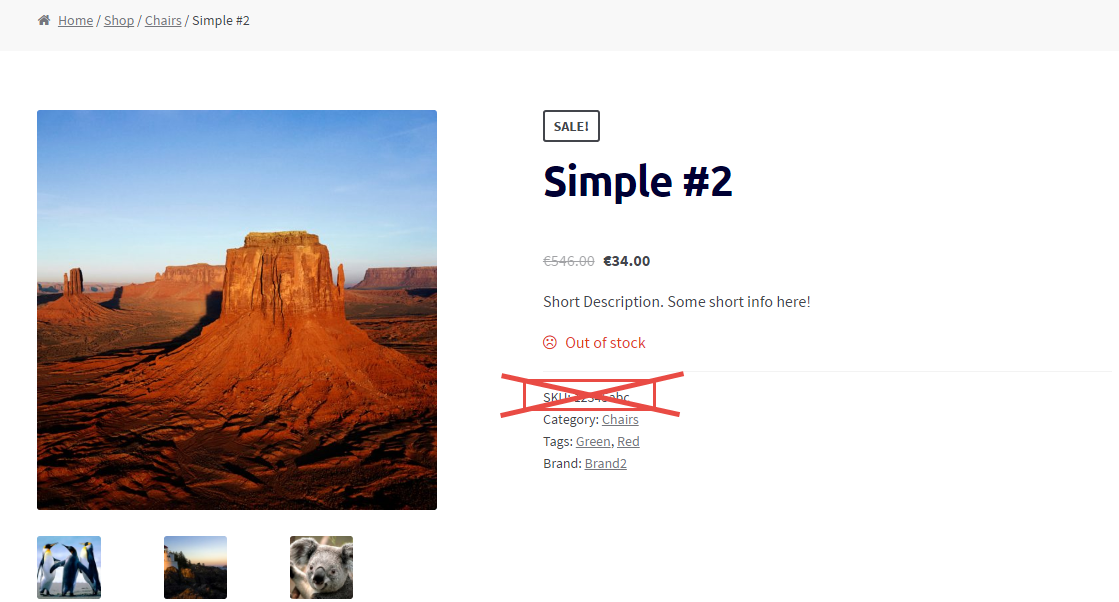
WooCommerce: Rename “Tags” Label @ Single Product Page

A #CustomizeWoo student reached out for premium support in regard to “WooCommerce taxonomies”. The question was: How do I change the label “tag” into something else, for example “brand”? Well, this is how it’s done!

Please note that this does not change the “tag” permalinks (URL, slug, etc), but only the “Tags” label on the frontend, and only on the Single Product Page.

Continue reading WooCommerce: Rename “Tags” Label @ Single Product Page

WooCommerce: Enable Payment Gateway Only for “Order Pay Checkout”

I invoice clients via WooCommerce, and then send them the “Invoice Email”, which takes them to the “Order Pay” page. Of course, I want to give them the option to pay via “Bank Transfer” (bacs), but I don’t want this to be visible on the default checkout page.

We’ve seen in the past how to disable payment gateways given certain conditions… but how do we “enable” one? Here’s a snippet for that – enjoy!

Continue reading WooCommerce: Enable Payment Gateway Only for “Order Pay Checkout”